
Witness nature's greatest spectacle on our signature 7-day Great Migration safari, specifically timed and positioned to bring you face-to-face with the largest overland wildlife migration on Earth. Each year, nearly two million wildebeest, zebras, and gazelles traverse the Serengeti-Mara ecosystem in a relentless cycle of survival, and this itinerary places you at the heart of the action. Based in a premium mobile camp that follows the herds, you'll spend five extraordinary days in the Serengeti, including the northern reaches where the dramatic Mara River crossings occur. This is our most sought-after itinerary — a once-in-a-lifetime experience that defines what an African safari can be.
Witness dramatic Mara River crossings
Premium camp follows the herds
Maximum time with the migration
Grand finale at Africa's Garden of Eden
This itinerary is specifically designed for the peak migration periods. From July through October, the herds are in the northern Serengeti and the Mara River crossings are at their most dramatic — this is the optimal time for this safari. From January through March, the southern Serengeti hosts the calving season when over 500,000 wildebeest calves are born within a few weeks, attracting abundant predators. We adjust the camp location and daily routing based on real-time migration intelligence to ensure you're always in the right place at the right time.

Take a morning flight from Arusha to the Kogatende airstrip in the northern Serengeti, placing you directly at the epicenter of the Great Migration. Upon landing, your expert guide will be waiting with your private vehicle. The drive from the airstrip to camp is itself a game drive — you may encounter vast herds of wildebeest and zebras within minutes. Arrive at your premium mobile camp in time for lunch, then head out for an afternoon game drive along the Mara River. Watch for massive crocodiles lurking in the water and hippos jostling for territory. The northern Serengeti's rolling hills and riverine forests provide a stunning backdrop for wildlife photography. Return to camp for sundowners and dinner under the stars.

Today is dedicated to witnessing the most dramatic event in the natural world — the Mara River crossing. Your guide will use real-time intelligence from our network of spotters to position you at the river before the herds arrive. When the crossing begins, the spectacle is overwhelming: thousands of wildebeest surging down steep banks, plunging into crocodile-infested waters, and scrambling up the opposite side in a desperate bid for survival. Some make it; others don't. It's raw, primal, and utterly unforgettable. Spend the full day along the river, with a picnic lunch, watching multiple crossings if they occur. Even between crossings, the riverbanks teem with wildlife — basking crocodiles, nervous zebras, and waiting predators. Return to camp exhilarated and exhausted.

Where the migration goes, predators follow. Today focuses on the carnivores that shadow the herds — lions, leopards, cheetahs, and hyenas. Start with an early morning drive to locate lion prides that have been hunting through the night. The northern Serengeti's rocky kopjes provide perfect vantage points for lions, and your guide knows each pride's territory intimately. Watch for cheetahs using the open plains for high-speed hunts, reaching speeds of 112 km/h. Leopards may be spotted in the riverine forests along the Mara and its tributaries. After lunch and a rest at camp, venture out again in the late afternoon when predators become active again. The golden-hour light on the Serengeti with a lion pride in the foreground is a photographer's dream.

After a final morning in the north, drive south through the Serengeti's changing landscapes toward the central Seronera region. This is a game drive in itself — the transition from the rolling northern hills through the Lobo Valley to the open central plains reveals the Serengeti's remarkable diversity. Stop at the Lobo Kopjes, where leopards are frequently spotted, and the Bologonja Springs, a hidden oasis teeming with wildlife. Arrive at your central Serengeti camp in the late afternoon, nestled among acacia trees. The Seronera area is known as the "big cat capital" of Africa, with the highest density of predators on the continent. Enjoy dinner at camp and the sounds of the African night.
A full day exploring the central Serengeti's Seronera Valley, one of the richest wildlife areas in all of Africa. Start before sunrise to catch predators at their most active. The Seronera River provides year-round water, attracting wildlife from across the plains and creating one of the most reliable game-viewing areas in the Serengeti. Visit the Maasai and Moru Kopjes, granite outcrops that serve as lookout points for lions and refuges for hyraxes and rock pythons. The Retima Hippo Pool offers close-up views of hundreds of hippos jostling for space. Optional: take a dawn hot air balloon flight over the Serengeti plains, floating silently above the herds before a champagne breakfast in the bush ($600 supplement). The afternoon drive explores the Namiri Plains, a cheetah stronghold recently opened to visitors.

Enjoy a final Serengeti sunrise and morning game drive before departing south through the Ngorongoro Conservation Area. The drive itself offers excellent wildlife viewing — you may spot cheetahs, ostriches, and gazelles on the southern plains. Visit Olduvai Gorge, the "Cradle of Mankind," where the Leakey family discovered fossils of our earliest ancestors dating back 2 million years. A Maasai boma visit offers insight into the traditional pastoralist culture that has coexisted with wildlife for centuries. Arrive at your lodge on the Ngorongoro crater rim in the late afternoon, where panoramic views of the 260-square-kilometer caldera stretch before you. Enjoy a celebratory farewell dinner at the lodge.
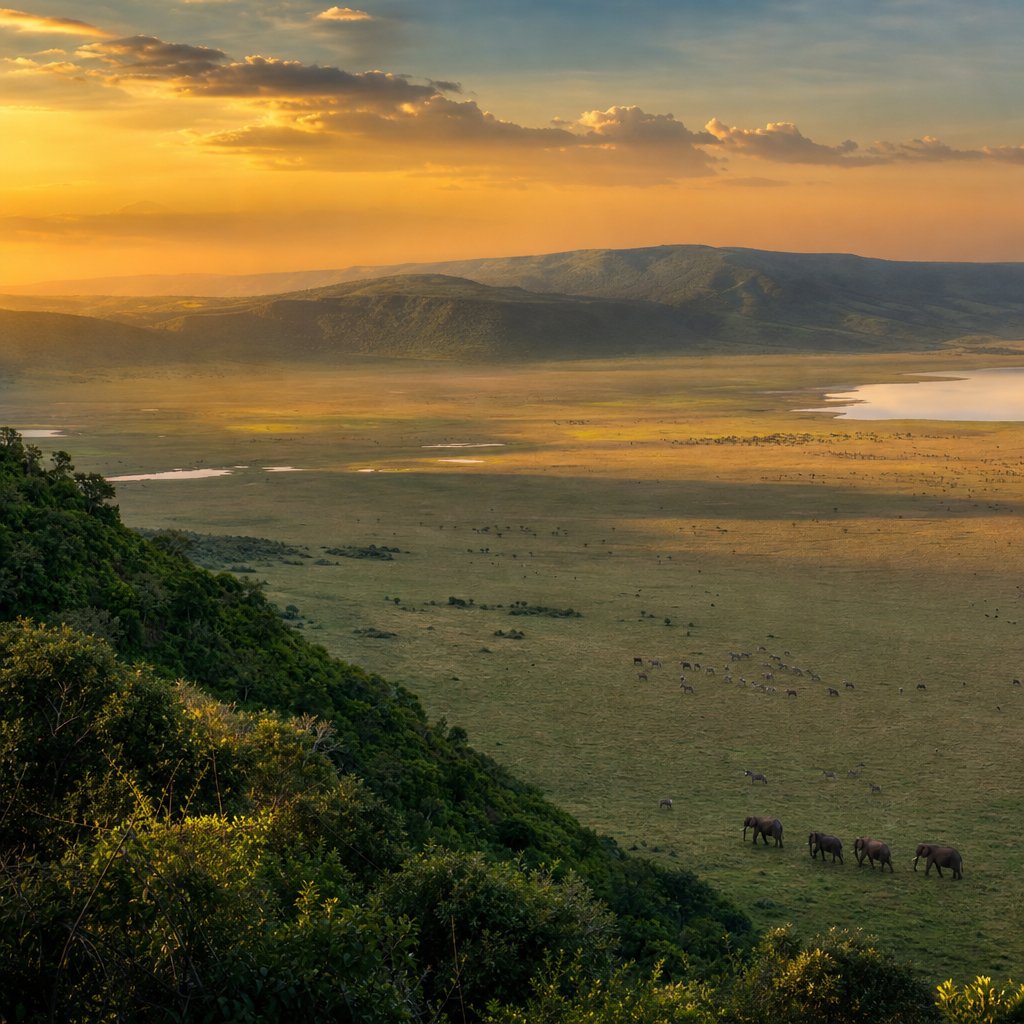
The grand finale — descend 600 meters into the Ngorongoro Crater, the world's largest intact volcanic caldera and a UNESCO World Heritage Site. The crater floor is a self-contained ecosystem supporting approximately 25,000 large animals, including the densest population of lions in Africa, endangered black rhinos, large-tusked elephants, and massive herds of buffalo and wildebeest. The shallow soda lake at the center attracts flamingos and other waterbirds in their thousands. Enjoy a picnic breakfast by the hippo pool, watching these massive animals lounge in the shallows while fish eagles call from nearby trees. After a morning of extraordinary game viewing, ascend the crater wall and drive back to Arusha through the Great Rift Valley, arriving in the late afternoon. Drop-off at your hotel or Kilimanjaro International Airport.
Prices are per person based on double occupancy. Single supplement applies.
| Season | Dates | Price (PP) | Single Supp. | Status |
|---|---|---|---|---|
| Green Season | Jan–Mar | $4,400 | $700 | Available |
| Shoulder | Jun, Nov | $5,200 | $850 | Available |
| Peak Migration | Jul–Oct | $6,200 | $1,000 | Limited |
Found a lower price for the same tour? We'll match it. All prices include park fees, premium camp accommodation, meals, internal flights, and migration-tracking services.
| Day | Accommodation | Type | Rating |
|---|---|---|---|
| Days 1–3 | Serengeti Under Canvas (Northern Camp) | Premium Mobile Camp | ★★★★★ |
| Days 4–5 | Serengeti Pioneer Camp | Premium Tented Camp | ★★★★ |
| Day 6 | Ngorongoro Serena Safari Lodge | Premium Lodge | ★★★★★ |
Fly into Kilimanjaro International Airport (JRO), approximately 60 km from Arusha. Most international airlines serve JRO including KLM, Ethiopian Airlines, Qatar Airways, and Turkish Airlines. On Day 1, you'll take a light-aircraft flight from Arusha to Kogatende airstrip in the northern Serengeti, placing you directly at the migration's epicenter.
Your guide will pick you up from any hotel in Arusha city center or from Kilimanjaro International Airport. Pickup time is typically 7:00 AM on Day 1 for the flight to the northern Serengeti. An overnight stay in Arusha before the safari is strongly recommended.
The Arusha-to-Kogatende flight departs at approximately 8:00 AM and arrives around 10:30 AM with a possible stop at Seronera. Luggage is limited to 15 kg in soft-sided bags. Excess luggage can be stored at our Arusha office. The return on Day 7 is by road through the Ngorongoro Conservation Area.
Most nationalities can obtain a visa on arrival at JRO for USD $50 (USD $100 for US citizens). An e-visa can also be obtained online before travel. A valid passport with at least 6 months remaining and one blank page is required. Yellow fever vaccination certificate is required if arriving from an endemic area.
Arusha, Tanzania • Established 2015
Nashivai Safaris is a locally owned and operated safari company based in Arusha, Tanzania. Our Great Migration safaris are led by specialist guides who have tracked the migration for over a decade, using a network of real-time spotters and satellite data to position you at the heart of the action. We are recognized as one of East Africa's premier migration safari operators.
"We saw THREE river crossings in two days! Our guide somehow knew exactly where and when the herds would cross. The mobile camp was incredibly comfortable, and falling asleep to the sounds of wildebeest was surreal. This was the trip of a lifetime."
— Sarah & David L., USA • August 2024"The migration is something no photograph or documentary can prepare you for. The sheer scale is overwhelming. Nashivai's expertise in positioning us at the right place was invaluable. The Ngorongoro Crater was the perfect finale. Outstanding from start to finish."
— Kenji T., Japan • July 2024